
Towards our places – Kantharodai
Towards our places – Kantharodai
Our hometown, Kantharodai, would be incomplete without mentioning the Buddhist relics found there.
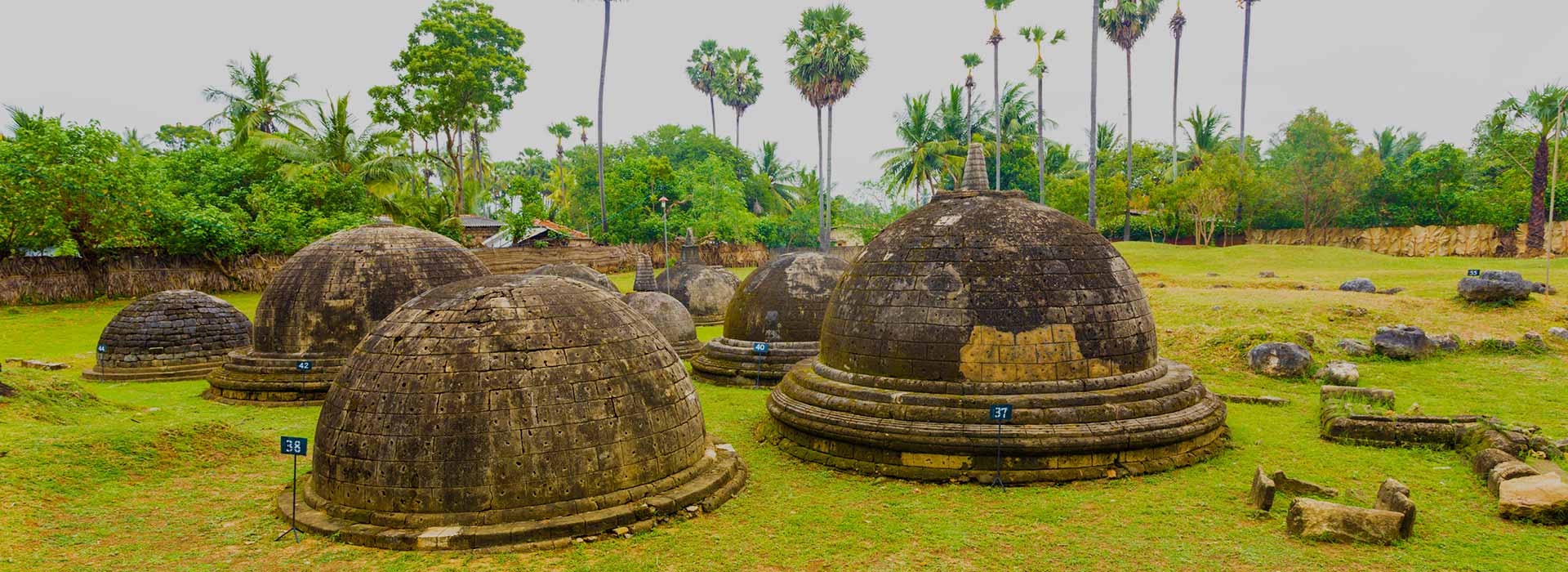
In a locality within Kantharodai known as ‘Kayakeni,’ there exists a significant number of Buddhist stupas. Historians often cite these as evidence that Buddhism once flourished in this region.
The “Nambotha”, a Buddhist Pali text composed around the 14th century CE, lists ‘Kathuru-goda’ (Kantharodai) as a site containing places of Buddhist worship (Rasanayagam 2003: 233, 234). However, historians remain divided on whether the followers of Buddhism here were Sinhalese or Tamil.
- Pathmanathan notes that the Buddhist relics at Kantharodai are situated above layers containing artifacts from the Megalithic culture. He further observes that the Buddhist structures at Kantharodai possess unique characteristics, distinguishing them from those found in places like Anuradhapura, Mihintale, or Magama. Specifically, they consist of numerous small stupas built near one another; these served as “pallipadai” – funerary monuments – for deceased members of the “Sangha” (Buddhist monastic community). Similar dome-shaped structures are also found in the Andhra region, at sites such as Amaravati and Nagarjunakonda, where they were constructed over the burial pits containing the remains of departed Buddhist monks. (2011: 55)
It is also noteworthy that C. K. Sittambalam (1993: 15) has pointed out, “In a sense, these symbols are funerary markers. One can observe that the ashes of deceased Buddhist monks were interred within caskets made of coral stone.” Many historians hold the view that no structures identifiable as Buddhist viharas (monasteries) or places of Buddhist worship have been found at Kandarodai. It is significant that several Buddha statues were discovered during excavations at Kayakeni. Regarding this, some offer the following explanation: In ancient times, travel and trade between India and the kingdom in southern Sri Lanka (the Anuradhapura Kingdom) largely took place via Jambukolapattana (Mathagal).
Kandarodai served as a key transit point on the route from Jambukolapattana to Anuradhapura (Ya.Vai.Vi. 27). There was a “madam” (a lodging or rest house) at Kandarodai for pilgrims. The site is still known today as ‘Madathadi’ (meaning ‘the place of the “madam”’).
It is said that King Gajabahu, upon returning from a journey to the Chera kingdom, disembarked at Jambukolapattana and stayed at Kandarodai. It was during this time that he established a temple for the goddess Kannagi at a location known as Anganam Maikkadavi. Therefore, it is possible that sixty Buddhist monks from India – traveling either with the intention of reaching Anuradhapura or for the purpose of propagating Buddhism -disembarked at the port of Jambukolapattana and stayed at Kandarodai. They may have brought several Buddha statues with them. While they were staying in Kantharodai, they traveled to Velanai – perhaps for the purpose of religious instruction or for some other reason. There, they consumed food that turned out to be poisonous, which led to all their deaths. The people of Kantharodai, who held them in high regard, likely brought their bodies back to Kantharodai, cremated them, and erected stupas in their memory.
As previously mentioned, since speakers of an Andhra language (“Vadugar”) had settled in places like Ottankattu for professional reasons – and given that they, too, may have been Buddhists – it is highly probable that they were the ones who constructed the stupas found here. That is why these stupas resemble the architectural style found in the Andhra region.
- K. Sittambalam – who notes that a total of twenty-two stupas have been identified at this site – also states that they belong to different periods. This casts doubt on the credibility of the narrative (1993: 15, 582).
It is also pertinent to consider another point. Generally, when a region is occupied and brought under the control of people of a different religion or language, it is common for them to establish their own religious shrines and monuments there. Just as Shaivite temples were built in places like Anuradhapura and Polonnaruwa, it is quite possible that Buddhist monuments were established in Kantharodai during a period when the authority of the kings from southern Sri Lanka held sway.
The discovery of both ‘Northern Brahmi’ and ‘Tamil-Brahmi’ inscriptions at Kantharodai serves as a significant example of the historical connection between the Tamil people and Buddhism – a view also highlighted by Pushparatnam (29). Nevertheless, it would not be accurate to conclude from this that Buddhism was deeply rooted here. The truth will only emerge when historians, maintaining an objective stance, conduct comprehensive research in Kantharodai and its surrounding areas – such as Anganammaikkadavai and Kathiramalai (Sunnagam) – and present their findings. Until then, we must wait.
— From the book “Kantharodai: Standing the Test of Time” by S. Sivasunmugaraja, M.D.(S).
(Translation by Tamilpriya)
0 Comments