
A Study of Special Terms Found in Philosophical Inscriptions of Eelam
A Study of Special Terms Found in Philosophical Inscriptions of Eelam
Parumaka (This was a general term referring to everyone. The earliest inscriptions used the form Parumakan. Later, the form Parumakanth can be seen. Its feminine form was Parumakal. All these forms subsequently disappeared, and the term Parumaka came into use.)
(1) Parumaka Sumana puta Parumaka Tisaha leṇe.
(The cave of Tisa, son of Sumana.) Upasaka was the first stage in the philosophical tradition of that period. Its feminine form was Upasika.
(2) Jotitheraha Mahasutasane Upasaka Tisaya Theraha Naga leṇe. (The cave of Naga, belonging to Tisa, the Upasaka of the elder Joti, son of Mahasuta.) Itaskita theraha sativisariya Sumana Kuttasa jita Kanaka rakiya Upasika Tisaya leṇe.
(The cave of Tisa, the Upasika protected by Kanaka, who had conquered Sumana Kutta, the elder Itaskita, who lived for one hundred and twenty years.) Kutta was the next stage after the Upasaka stage in the philosophical path. Its feminine form was Samaniya.
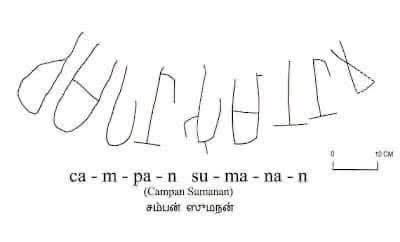
(3) Parumaka Sumana putaha Chuta Sumanahe pata Tisakuttaha leṇe.
(The cave of Pada Tisakutta, son of Parumaka Sumana and known as Chuta Sumana.) Tisa Samaniya leṇe. (The cave of Tisa, the female ascetic.) Datta was a higher stage than the Kutta stage.
(4) Jotisana therasa ativasa Pada Sumana Datta therasa leṇe.
(The cave of Sumana Datta, the Pada Ativasa of the elder Jotisana.)
Thus, the same individual was referred to by different titles according to the stages he had attained: Parumaka, Upasaka/Upasika, Kutta/Samaniya, Datta, and, at an even higher level, Therasa.
There is another very important point.
Parumaka Sumana putaha Chuta Sumanahe pata Tisakuttaha leṇe.
This means: “The cave of Pada Tisakutta, who was the son of Parumaka Sumana and was also known as Chuta Sumana.”
Thus, Chuta Sumana means “young Sumana.” Even among the present generation, there is a custom of using names such as Chutti or Kutti. Therefore, we can see that Tisa, the son of Sumana, was addressed as Chuta Sumana, meaning “young Sumana,” after he had advanced to the Kutta stage and attained the status of Pada.
In the same way, we can understand the meanings of terms such as Chuta Naga, Chuti Tisa, and Kutta Gotama Samane.
Translation by Hari
0 Comments