
Evidence of Stone Age Human Settlements Discovered in the Panikkankulam Forest Region
Evidence of Stone Age Human Settlements Discovered in the Panikkankulam Forest Region
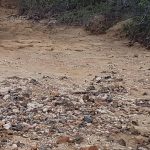
Stone tools used for hunting by prehistoric humans have been discovered along the banks of the Panikkankulam River, in a forested area approximately ten kilometres south of the main road between Kokavil and Maankulam.
Two residents of Panikkankulam, Mr. Gajan and Mr. Jeyakanthan, sent us a photograph of a black stone found along the riverbank in the forest. The stone appeared to have been used for grinding grain.
Because the shape of this stone and its apparent function suggested considerable antiquity, we visited the location this week together with archaeology lecturer Mr. K. Kirikaran.
Mr. Gajan and Mr. Jeyakanthan assisted us in reaching the site.
Archaeological Evidence of Ancient Settlements
At present, only a few settlements are found within approximately one mile of the main road in this forest region.
The remaining territory, extending as far as Vannerikkulam, consists of dense forest that is largely unsuitable for human habitation.
However, reliable archaeological evidence found in considerable concentrations along both banks of the river confirms that densely populated settlements existed in this area as early as 2,000 years ago.
Among the archaeological materials discovered on the elevated ground near the river were pottery fragments of various sizes and shapes, bricks, iron deposits and everyday objects fashioned from black stone.
These discoveries resemble archaeological evidence associated with the Early Iron Age, also known as the Megalithic cultural period, found at several important sites.
In Eelam, comparable evidence has been discovered at Kantharodai, Kaddukkaraikulam and Anurathapuram.
In Tamil Nadu, similar archaeological remains have been found at Adichanallur, Alagankulam and Arikamedu.
Evidence of Stone Age Communities Before the Megalithic Period
An especially important aspect of these discoveries is the evidence suggesting that Stone Age communities inhabited this region before the emergence of permanent settlements associated with Megalithic culture.
These early inhabitants lived as nomadic hunter-gatherers, hunting animals for food.
Reliable evidence supporting their presence has been discovered along the riverbanks.
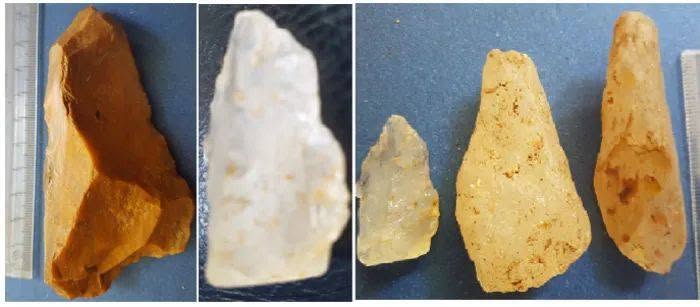
The finds include small, carefully fashioned stone tools made from quartz and chert, together with stone flakes produced during the manufacture of these implements.
These discoveries indicate that Mesolithic or Microlithic communities lived in this region several centuries before the emergence of Megalithic culture.
The Prehistoric Cultural History of Eelam
Although it is believed that Palaeolithic communities inhabited Eelam, the continuous reconstruction of its human and cultural history becomes possible primarily from the Mesolithic or Microlithic period onward.
According to the chronological estimates presented here, two major prehistoric cultural phases can be identified.
37,000–3,000
years ago
Mesolithic / Microlithic Culture
Characterised by a nomadic way of life, with communities relying on hunting and gathering for survival.
3,000–1,700
years ago
Megalithic Culture / Early Iron Age
Characterised by the development of permanent settlements, which laid the foundations for later civilisation.
According to the archaeological interpretation presented in the article, both these cultural traditions and the communities associated with them migrated to Eelam from southern Tamil Nadu.
The discovery of archaeological evidence belonging to both cultural periods in the Panikkankulam forest region therefore provides important new information about the ancient history of northern Eelam.
A Proposal to Protect the Archaeological Site
Considering the historical and archaeological significance of these discoveries, a decision has been made to submit a request to the Director-General of the Department of Archaeology of Eelam.
The request will seek to have the Panikkankulam site officially declared an archaeological heritage site, ensuring that its prehistoric remains are recognised and protected.
The discoveries at Panikkankulam may contribute significantly to our understanding of prehistoric human habitation, cultural development and the earliest settlement patterns in northern Eelam.
Translation by Hari

0 Comments