
Lt. Col. Akbar
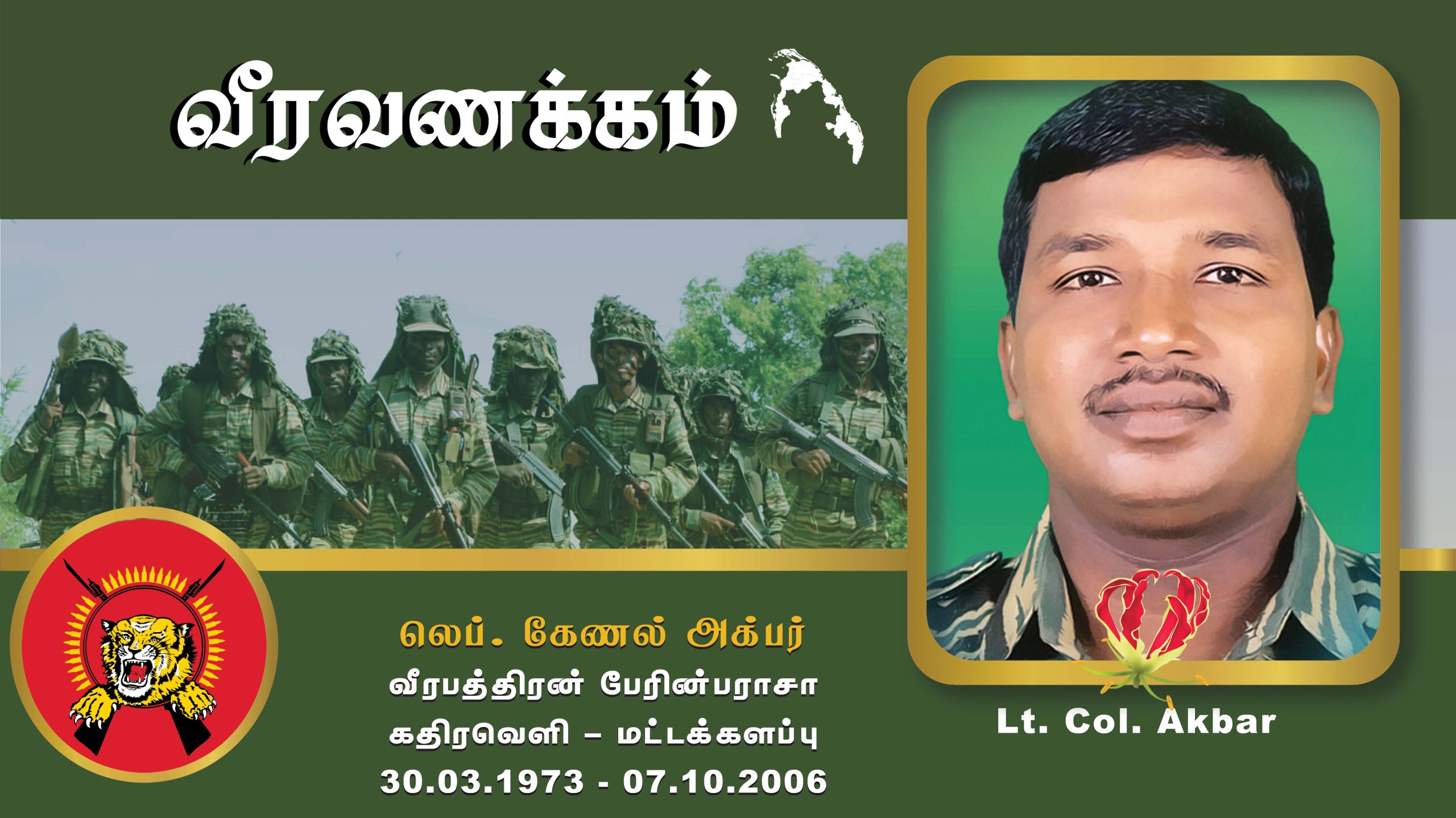
Lt. Col. Akbar
Lt. Col. Akbar is at the command post of the northern front. The communication device is searching for Akbar. There is no contact. He told Commander Theepan that he was going to the rear base to prepare the team leaders after inspecting the front lines in the morning. He has not arrived yet. 3.00 pm Akbar is not in touch. 5.00 pm no contact. 8.00 pm no contact.
The commander is suspicious. Akbar would never have remained without contact for so many hours when the enemy could advance at dawn tomorrow. As time passes, the commander and the other fighters are filled with longing. Has something happened to him? How could we lose him? Everyone was looking for him. He was a valuable hero. He has many achievements on the battlefields. We also need him tomorrow. Where has he gone?
Akbar was born, raised, and grew up in the sunshine of Mattacalappu. The struggle and his family were closely linked. His brother was a fighter at the time. Indian forces entered the village, went door to door, and dragged the youth out onto the streets and tortured them. Akbar was no exception to these tragedies. They came into his house and dragged him out. They put him in a cart and took him to the camp, tied him up and tortured him. They tortured him by saying that his brother was a fighter. These influences made him a fighter too.
He came to Vanni in 1990 and received basic training in Manalaru, and his long struggle life began. He engaged in many secret missions and rigorous training and participated in small battles and developed himself into a great warrior. Akbar’s development potential was fully evident during the Surya Rayal counter-operation. He bravely engaged in reconnaissance operations to stop and attack the advancing enemy. Attacks were also carried out according to the reconnaissance he saw. Having met the battlefields as an ordinary fighter, he grew up to be a team leader leading ambush team.
It was during these days that the national leader planned and prepared a massive military operation named Oyaatha Alaigal – 01 on the Sri Lankan army base in Mullaithivu. Akbar was appointed as the assistant commanding officer of the Imran Pandian Brigade’s breakthrough team for this attack. The Sinhalese were stunned when the enemy landed on the Mullaithivu base at an unexpected time. The national leader knew very well that they would not want to lose the Mullaithivu base, which was a stronghold of Yarlpanam occupation, and would try hard to retain it until the end. The national leader, who had learned that the Sinhalese army would make a landing to save the Mullaithivu forces, kept the teams ready.
As expected, the Sinhalese army arrived and landed at Alampil. A fierce battle took place there. Akbar, who was the commander in charge, entered the field when the battle became tense. He led the team skillfully. He killed the enemy on the ground in a flash. When the battle of Mullaithivu ended and the waves of the battle – 01 Act 1 triumphed, Akbar emerged as a great fighter.
The Sinhalese forces, defeated at Mullaithivu, launched an operation to encircle Kilinochchi under the name of ‘Sathjeya’ to eliminate their symbols of shame. The LTTE fighters who faced the Sinhalese forces in Paranthan put up a fierce fight. The Sinhalese forces were entering our areas with tanks. Akbar, who was giving orders 500 meters away from the scene of the fight, understood the tense situation of the fight and immediately ran towards the scene of the fight. He immediately decided to join three fighters who were standing there and were firing RPGs and launched a daring attack on the advancing tanks. Two tanks were burned and destroyed in this attack. In a critical situation, Akbar’s quick and sophisticated plan was successfully implemented. Akbar was the main reason for stopping the enemy’s advance that day.
The national leader spent a lot of time planning to thwart the ‘Jayasikuru’ operation, which was about to begin with the grand slogan of the then Sri Lankan Deputy Defense Minister Ratwatte, to seize the A-9 road and open the land route to Yarlpanam. The national leader also understood that the enemy would use tanks a lot. When he decided to form a brigade to destroy these tanks and looked for someone to be the commander for it, Akbar’s face appeared in the national leader’s eyes as a suitable one. The national leader recognized Akbar’s talent in the Satjeya breakthrough battle. Under Akbar’s leadership, the specially trained fighters of the Imran Pandian Brigade were formed into the Victor Special Anti-Armor Team. Everyone who entered this regiment underwent rigorous training. Starting from Akbar to the ordinary fighter, everyone entered this regiment only after training and passing the examination.
Even though Akbar was a commanding officer, he fulfilled all the duties assigned to each fighter. He paid attention to every small detail. He reduced the distance between himself and the fighter and established a close, tight relationship. He would encourage other fighters to participate in all the rigorous training. His aim was not to let any fighter fail the training examination. He would repeatedly train those who failed the examination and make them pass. Not only did he not stop with the training, but he would also personally ensure that the fighters were fed. Once, while boiling the cow’s milk given to the fighter at noon, they burned it. After that, he would boil milk himself and give it to the fighter whenever he was standing. If the fighters made a mistake or acted carelessly, the action he would take would be a lesson to the fighters so that they would not make such mistakes in the future.
One day, the fighters were bathing in a well. Akbar also came to the well to bathe. When he took a cursory look at the situation, he found that the well had not been cleaned that morning, and traces of the materials used were still there. Akbar did not say anything. He did not criticize anyone. He went to the gold house and brought a lamp and cleaned the well himself. Only then did the fighters wake up and try to clean it. Akbar did not let anyone do it. That day, he cleaned the area completely. Even after that, he did not talk to anyone about it.
This act of Akbar made the eyes of the fighters tear. After that, the fighters never made that mistake. This characteristic of Akbar and his ability to find a solution to the mistakes of those who made mistakes without hurting anyone else, earned him a fatherly status among the fighters. Akbar followed this decision not only in holding a broom but also in holding a weapon and firing on the field. This was the basis for Akbar’s peak development.
The national leader formed this team with long expectations. On Monday, May 13, 1997. Taking a bow before Buddha, the Sinhalese launched a massive military operation in Vanni under the name of ‘Jayasikuru’. The LTTE forces, who were ready, faced the enemy face to face on the field. The enemy, who stood below us in strength of mind, stood above us in strength of arms. During the fighting, he sent tanks to the front, sieved our guards with the tanks’ fire hoses, and sneaked into our areas under the cover of those iron shields. Anticipating this situation, Akbar’s team, which was ready for it, directly met the field. The enemy paid a high price for conquering every inch of ground. 25.05.1997 Our troops fought a fierce counterattack in Mankulam. The tanks moved forward in large numbers. Akbar was standing in the guard post giving orders and leading his fighters carrying RPGs. The fighters stood close to the enemy and fought. The fight escalated and turned into a hand-to-hand fight.
It was at this time that the news of the heroic death of RPG commando hero Babu reached Akbar’s ears. The pulse in Akbar’s veins increased. He could not bear it when the fighters he had raised with so much love were dying. He ran straight to the scene of the battle. His anger at the enemy was greater than the impact of the shells that fell and exploded there. Akbar, a commander, stood next to his fighters on the field, like a teacher giving a lesson in a school class, showing them how to destroy the tanks without paying attention to the shells that were rushing through the field and the fragments of the shells that were trying to tear their bodies apart like pieces of fire. The ground of the Irambaikkulam trembled. At that time, Akbar stood alone among them and gave a strong blow to the enemy’s armored force by destroying two tanks and a tank destroyer and damaging two tanks. By repelling this attack, Akbar gave confidence to the commanders who were leading the entire field in the excellent performance of the Victor Special Anti-Armor Team.
On 10.06.1997, our troops launched a powerful attack on the Jayasikuru force that had set up a base in Thandikulam. In this field too, Akbar launched a platoon of fighters to thwart the movement of the enemy’s tanks. The fighting was fierce. At one point during this attack, Akbar was wounded in the stomach. The pain of the stomach wound was greater than the pain of the enemy’s attack on our country. He bandaged his wound with a bandage and continued to lead his team in the fight. In this fight, he attacked and destroyed two tanks and damaged a tank, and only after the attack came to a halt did Akbar return to the battlefield.
The team leaders he nurtured were also responsible for the victories achieved by Akbar on the battlefields. He instilled in them the virtues he possessed. He also gave them the opportunity to make independent decisions when they needed to act. Our troops fought by forming a strong defensive wall at Puliyankulam, which advanced step by step while suffering heavy losses.
On the morning of 19.08.1997. Tanks and troop transports, which came at high speed, creating a huge noise, entered our base at the Puliyankulam junction, bypassing our defenses. Understanding the situation and waking up, our teams sieved the enemy inside the camp. Major Kaverinathan gave the command to the RPG commando fighters and led them, and they fought fearlessly with the enemy who entered the camp, destroying two tanks, capturing a troop carrier and damaging some others, shattering the enemy’s dreams and sending them running. Even though Akbar was not on the field during this battle, the team leaders and fighters he had trained up upheld the name of the Vikram Special Anti-Armor Team.
In every battle, he created a wall so that the enemy’s tank force would tremble when it saw a long wall. If tanks could ever talk, they would also talk about how they trembled and cowered. Because that is how Akbar achieved this on the battlefield with his fighters.
Oyaatha Alaigal – 02 Operation, The Vikram Special Anti-Armor Team was planned by the national leader and was attached to the teams that penetrated Kilinochchi city and Paranthan and attacked the enemy in two. As the fighting began, the penetration teams entered. The Kilinochchi base was isolated. The teams were engaged in field operations to stop the enemy who was trying to advance from both sides into the fields. When they tried to attack the Kilinochchi base by pressing on multiple fronts, the troops advanced with tanks from Paranthan to connect Kilinochchi with them. The other brigade fighters and the Victor Special Anti-Armor Squad fighters who had blocked their path fought fiercely.
At that time, Akbar, who was coming to check and confirm the positions, was also approaching the A-9 main road. After handing over the responsibility of attacking and destroying the advancing tanks to Manivannan, he himself attacked a troop convoy coming towards his position by taking the RPG of a commando soldier standing nearby. It was in this attack that Lt. Col. Manivannan also attacked and destroyed a tank. As their armor was broken, the enemy’s reconnaissance was also broken. Their dream of connecting Paranthan and Kilinochchi failed. The Sinhalese force of Kilinochchi fled from Kilinochchi.
Akbar’s brigade also left its mark on the Ranakosa operation carried out in the Pallamadhu area on 26.06.1999. In this battle, the enemy used additional tanks to carry out the tank movement. This was a challenging battle for the RPG team. The tanks scattered rockets all over the ground. Akbar gave clear orders while standing on the ground where there was not much cover. The fighters, who were unstoppable, fought fiercely as per Akbar’s orders. At the end of this battle, seven fighters had given their lives for the liberation of the homeland and had destroyed six tanks. The strength of the enemy’s armored force was disrupted by the special anti-armor team. In this way, Akbar revealed himself through his actions wherever the Jayasikuru force entered.
Akbar’s code name was ‘Alpha – 1’. When ‘Alpha – 1’ came on the field, new blood would flow in the bodies of all the fighters. When ‘Alpha – 1’s’ men came on the field, the enemy would sweat. That is how Akbar achieved it. Akbar could take decisions and act independently in any situation and at any time. As soon as the news reached Akbar that the enemy had entered our area through a secret move with the aim of encircling the Oddusuddan area, he immediately took the RPG launchers of his fighters and gave them rifles in their hands and told them to prepare the team. Akbar rushed to locate the enemy’s advanced positions. At that time, Akbar’s camp was in the area close to that place. He immediately created a blocking position without allowing the advancing enemy to move and brought the situation under control until the other attack teams took over the place.
When Akbar and his men made a landing at Ittavil to capture Aanayiravu and fought for a month, they defeated all the enemy’s armored forces and destroyed many of their armor. Akbar and his men played a major role in the defeat of the Sinhalese at Ittavil and the victory of the LTTE over Aanayiravu.
When the enemy launched a massive military operation called ‘Operation Flame’ with the aim of recapturing Aanayiravu, which had fallen to the LTTE, he did not prioritize tanks. During the ‘Jayasikuru’ field battles, Akbar destroyed Israeli-made tanks and armored vehicles. He made their turrets and guns subservient to his own. Overall, he rendered the effectiveness of tanks in the field useless. Just as the national leader had planned and created this special anti-armor unit, Akbar accomplished exactly what he had imagined in that dream without any mistakes with his team. He destroyed the strength of the iron armor and showed the strength of the freedom fighters to the world. Akbar performed many such tasks. Later, Akbar combined many teams and led teams that included many innovative weapons.
Then he went to work as the Andangula in-charge of Mattacalappu on the special instructions of the national leader. He did field work and public work together. He was always active, going even to distant places on foot, conducting reconnaissance and attacks, and fulfilling the needs of the people. Even as a commander, he considered himself a natural fighter, treated everyone with respect without discrimination, spoke politely, and spread a smile.
This hero was appointed as the Northern Front Commander of the Tamil Eelam National Auxiliary Force on 23.05.2005. Since then, he lived with them in the front lines and built them into an excellent force. When the enemy advanced in Muhamalai on 11.08.2006, if the National Auxiliary Force fought more or less than expected in the ensuing battles, Akbar was the root cause. If Akbar gave orders, they would achieve or die for the achievement. Akbar lived like that. This hero left us in the enemy’s shelling. The sage who accompanied him also died that day. Akbar’s division once shook the hearts of everyone from the commanders to the fighters.
The name Akbar had a strength on the field. The strength of every RPG commando hero was Akbar. When I shared the memories of that hero with the special commanders, he appeared like a treasure trove. Akbar was a virtuous warrior, a pure hero who had achieved great achievements without arrogance. A leader who accomplished what he set his mind to, a man who completed great tasks quietly at any time and in any resource shortage. He would do what he said and not say what he would do. A strategist who surpassed the strength of iron. Above all, Akbar was an asset to our army. Such an efficient hero walked silently among us. Even now, he has done a lot in the field. He died while preparing to revive the dormant RPG team and foil a major operation. Yet the power of that name still lives on. Even after Akbar fell, the fighters he raised crushed the enemy tanks. “The quality of leadership is not only when he is alive, but also when he falls, the fulfillment of his orders is the asset he sought.” Akbar sought this asset a lot.
Finally, Akbar had a wish and a dream. Akbar was a warrior who was married and had two children. He lived most of his life in the fields. He had little time to play with his children. Even if he went home for a while, he would not stay. His wife would stop him. He would understand her request. He would take her before the national leader’s picture. Showing the national leader’s picture, he would say, “My brother expects a lot from me. We should also act like my brother. If everyone works together with the brave fighters, we will soon get freedom. If we get freedom, I will go and live with my children and raise them in a beautiful way.” Then he left. As per the last wish of this noble warrior who did not live for himself, we should fight and give his children a bright future.
Remembrance Sharing: S. Puratchimaran
Publication: Viduthualaipulikal Magazine
(Translation by Tamilpriya)
0 Comments