
A Historical Perspective: From the Soulbury Constitution (1947)
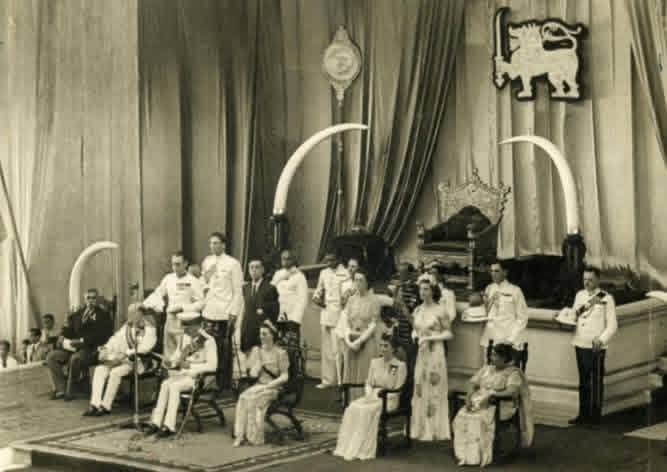
A Historical Perspective: From the Soulbury Constitution (1947) to the First Republican Constitution (1972).
Political rights of the Tamil people, protection of minorities, and shifts in the power structure.
The transition from the Soulbury Constitution of 1947 to the first Republican Constitution of 1972 marks a significant turning point in the political history of Sri Lanka.
This was not merely a transition from a British monarchy to a republic. It also brought about changes regarding the protection of minority communities, linguistic and religious rights, the powers of Parliament and the judiciary, and the overall political power structure of the country.
- The Soulbury Constitution – 1947 Under the Soulbury Constitution, formulated in 1947, Sri Lanka gained independence on February 4, 1948, with the status of a British Dominion. The British monarch served as the Head of State, represented by a Governor-General, while the Prime Minister led the government. The Parliament consisted of two chambers: the House of Representatives and the Senate. The country functioned under a unitary administrative structure with centralized power. No federal authority was granted to the provinces.
- Section 29 of the Soulbury Constitution Section 29 served as a crucial provision for the protection of minority communities. It restricted the granting of special privileges to any single community and prohibited the enactment of laws that would disadvantage another community. However, this protection was not absolute. The Citizenship Act of 1948 and the provisions of the Citizenship Act of 1949 significantly impacted the citizenship and voting rights of the Hill Country Tamils. Consequently, it is a historical fact that, despite the existence of Section 29, the rights of minority communities were, in practice, compromised.
- The First Republican Constitution (1972) Following the accession to power of the United Front government, led by Sirimavo Bandaranaike, in 1970, a new constitution was drafted. On May 22, 1972, Sri Lanka was declared a Republic. The British monarchy and the office of the Governor-General were abolished. The country’s name was changed from ‘Ceylon’ to ‘Sri Lanka’. The Senate was abolished, and a unicameral National State Assembly was established.
- Unitary State – Section 02 Section 02 of the 1972 Constitution explicitly defined Sri Lanka as a unitary state. While the Soulbury Constitution also featured a unitary central administration, it did not explicitly define the state as ‘unitary’ in the same manner as the 1972 Constitution. No separate constitutional authority or federal system of governance was granted to the Northern and Eastern provinces.
- Primacy Accorded to Buddhism – Section 06 The 1972 Constitution granted a special constitutional primacy to Buddhism. It was declared the duty of the State to protect and foster the ‘Buddha Sasana’ (the Buddhist dispensation). Provisions were also included to safeguard the rights of other religions. However, the same constitutional primacy was not extended to Hinduism, Islam, or Christianity.
- Status of Sinhala as the Official Language – Section 07 The 1972 Constitution affirmed Sinhala as the official language. The language issue, which had already intensified against the backdrop of the ‘Sinhala Only’ Act of 1956, became even more pronounced. The key demand of the Tamil people – that both Sinhala and Tamil be granted equal status as official languages – was not accepted.
- Repeal of Section 29. The specific protections for minorities, as provided under Section 29 of the Soulbury Constitution, were not carried over in the same form into the 1972 Constitution. Consequently, the specific constitutional safeguard against laws detrimental to minority communities was removed. This is considered a significant setback regarding the political protection of the Tamil people.
- Changes to Judicial Power. The 1972 Constitution placed great emphasis on parliamentary supremacy. Priority was given to constitutional review prior to the enactment of a law. Once a law was enacted, the opportunity to challenge its constitutional validity in court was severely restricted. As a result, the judiciary’s power of constitutional judicial review was curtailed.
- Fundamental Rights. The 1972 Constitution included a chapter on fundamental rights. Rights such as equality before the law, freedom of religion, freedom of speech, the right to assemble, the right to form associations, and freedom of movement were specified. However, these were subject to numerous legal restrictions. Furthermore, there was no robust judicial protection comparable to that found in the current Constitution. Therefore, it would be incorrect to claim that no fundamental rights existed at all. The accurate explanation is that the scope of their protection was limited.
10.1966 Special Provisions for the Tamil Language. Under the Tamil Language (Special Provisions) Act of 1966, regulations were introduced to expand the use of the Tamil language in administration. However, issues arose regarding the legal continuity of these regulations under the new 1972 Constitution. Consequently, dissatisfaction concerning Tamil language rights further increased.
- Opposition of the Tamil political leadership to the 1972 Constitution. Allegations were raised that the political aspirations of the Tamil people were not adequately considered during the process of drafting the new Constitution. Key demands put forward by the Tamil political leadership:
– Equal status for both the Tamil and Sinhala languages.
– Strong constitutional safeguards for minority communities.
– Devolution of power in accordance with the political aspirations of the people in the North and East.
– A federal system of governance.
– Linguistic equality in education, administration, and judiciary.
On June 28, 1971, an amendment regarding language – proposed by the Illankai Tamil Arasu Kachchi (ITAK) in the Constituent Assembly – was defeated by 87 votes to 13. Following this, the ITAK boycotted the proceedings of the Constituent Assembly and withdrew. On May 14, 1972, at a conference of Tamil political leaders held in Thiriconamalai, a resolution was adopted opposing the new Constitution. The Tamil political leadership also boycotted the event marking the enactment of the new Constitution on May 22.
- Political shifts among Tamils following 1972. Significant historical turning points in Tamil politics following the 1972 Constitution included: “Tamil political opposition to the new Republican Constitution of 1972.” The demand for a separate state, ‘Tamileelam,’ articulated through the Vaddukoddai Resolution on May 14, 1976.
The Tamil United Liberation Front (TULF) contesting the 1977 general election on the platform of a separate state. However, the 1972 Constitution was not the sole reason for the Tamil people’s demand for a separate state. Factors such as issues surrounding citizenship, language, the non-implementation of political agreements, ethnic violence, and challenges in education and employment have already fostered a sense of discontent.
- Key differences between the two constitutions. The Soulbury Constitution (1947):
– Dominion status under the British Crown.
– A bicameral (two-house) parliament.
– Specific protections for minorities under Section 29.
– No constitutional primacy granted to Buddhism.
– No federal devolution of power. The First Republican Constitution (1972):
– A republican form of government.
– A unicameral (single-house) legislature.
– Section 29 was not retained in its original form.
– Constitutional primacy granted to Buddhism.
– Sinhala established as the official language.
– A unitary state structure explicitly defined.
– The judiciary’s power of constitutional review was curtailed.
- Significant constitutional questions raised by this history:
- Can the political rights of other communities be determined solely by the will of the majority?
- Should a country’s constitution not safeguard the language, religion, identity, and political power of minority communities?
- Can a parliamentary majority possess unlimited legislative power?
- How should a constitution address the demands for power-sharing from the people of the North and East?
- Can a constitution, formulated without the consent and participation of affected communities, foster genuine national unity?
- Key insights to be drawn from history. The transition from the 1947 Soulbury Constitution to the 1972 Republican Constitution brought about a major shift in the structure of political power in Sri Lanka. Changes concerning the protection of minorities, linguistic equality, religious rights, the unitary state structure, and judicial authority left a profound impact on the political history of the Tamils. A nation’s constitution is not merely a document to ensure the rule of the majority- It must serve as a foundational political compact that safeguards the equality, dignity, language, religion, political participation, and rights of all people living within that country. A constitution should be crafted not only to consolidate the power of those who govern but also to protect the rights of the people who are governed.
– Compilation
– Freedom fighter Karthagan
(Translation by Tamilpriya)
0 Comments