
In Eelam – The Historical Stain of Indian Mankind 1987 – 1990
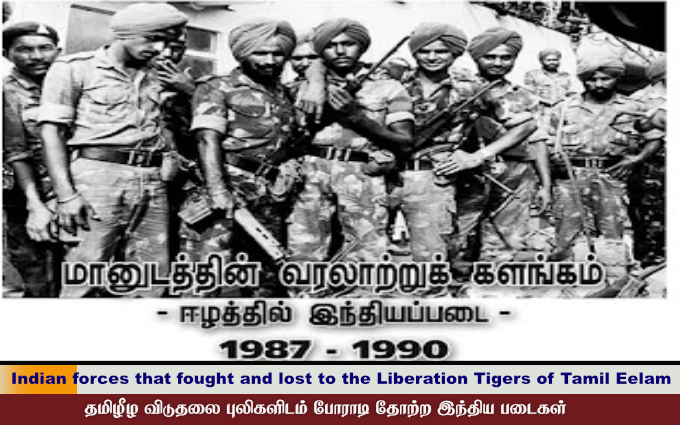
In Eelam – The Historical Stain of Indian Mankind 1987 – 1990
It has been many years since the Indian Army entered Eelam under the name of Peacekeeping Force and committed atrocities and war crimes.
At this time, the monthly magazine Thaiveedu, published from Toronto, has published a special section titled The Historical Stain of Mankind in its issue dated 2017. Considering its importance, I am sharing the preface to this collection and the PDF of the special section here.
The influence of India has had a huge impact on the culture and history of Eelam Tamils since historical times. Many Eelam Tamils have felt a connection with Indian identities, even beyond our unique artistic and literary cultural features. The media of Tamil Nadu – especially magazines, films and recently television programs coming out of Tamil Nadu – have played a role in creating and permeating this feeling. While this cultural infiltration continues to this day, the Indian Army in Eelam remains a bitter and unhealing memory in the memories of the Eelam people.
Since the time when the ethnic conflict in Eelam intensified, it was the basic belief of most Eelam Tamils that India would not abandon them. They believed that not only Tamil Nadu politicians and leaders, but also many Indian leaders were close to them and were approachable. Even now, it can be recalled from memories that until the eighties, large pictures of Indian leaders including Gandhi, Nehru, and Subhas Chandra Bose were hung in the halls of many Eelam Tamil houses. It must be said that especially in the early years, the fact that the armed training camps, accommodation facilities, and offices of the movements were in India further strengthened the people’s faith. However, for India, it handled the Eelam issue entirely for its own self-interest and for the hegemonic dream of establishing regional influence and played dice with the Eelam Tamils. It completely deceived the Eelam Tamils and staged atrocities in Eelam that would make humanity bow its head in shame.
Although the Sri Lankan government’s genocide against the Eelam Tamils took place in Mullivaikkal in the most brutal way, the Indian government had committed the various war crimes committed by the Sri Lankan government many years before that. In particular, the Yarlpanam Hospital massacre, the media being intimidated and destroyed to prevent the spread of war devastation, the shooting of those who surrendered with a white flag, the attacks carried out in areas declared as ceasefire zones, and the destruction of heritage and intellectual property were the first acts of the Sri Lankan government in Eelam to be carried out with the full consent of the Indian government, including the destruction of the media by threatening and destroying them and spreading false news.
It is important to note that neither the records nor the census of the destruction committed by the Indian Army in Eelam have been properly disseminated. While it is said that more than three thousand people were killed and more than seven hundred women were subjected to sexual assault, the losses are likely to be much higher and the destruction of property worth crores, psychological attacks, maiming and assault in a short period of time by the Indian government through the Indian Army is immense. Naturally, due to the soft attitude of many Eelam Tamils towards India and due to the influence in the Indian media, these destructions committed by the Indian Army are hidden, and arguments that justify it are being spread, and attempts are being made to destroy the very soul of humanity.

In the early days, the false data and information disseminated in the international arena through books in English and through opinion polls by those affiliated with the Indian Army, who were representatives of Indian hegemony dreams, helped to hide the truth from the eyes of the world. As a cruel continuation of this, it can also be seen that creators and writers have recently taken up activities that glorify the Indian military actions that killed humanity. It is widely said that history is always written by the victors and the dominant. Due to the contemporary consciousness that has arisen in historical writing, arguments are being put forward that the oppressed, the defeated and the marginalized should record their history, record their memories, and that by recording their collective memories, history can be moved towards the truth. By conducting remembrance events and recording their memories orally, through written records and through artistic and literary expressions, it is considered important and is considered a very important political activity of the oppressed, defeated and marginalized communities.
In that way, the Tamils of Eelam have a historical duty to continuously remember and record the injustices, atrocities, war crimes, and genocide committed against them. Consciously realizing this, we are publishing the August 2017 issue of Thaiveedu magazine as a special collection commemorating the destruction committed by the Indian army in Eelam. When we thought about the title of this collection, nothing else seemed appropriate except the historical stain on humanity, and even a brief description other than the historical stain on humanity did not seem appropriate to express the atrocities committed by the Indian army.
The Indian Army, which entered Eelam in July 1987 under the name of the Indian Peace Keeping Force at the request of the Sri Lankan government following the agreement between the Indian and Sri Lankan governments, removed its mask within a very short time. And when it left Eelam in March 1990, it was revealed that it was not a peacekeeping force but an army of Satan. At a time when records and collections about it are being destroyed and destroyed, and when false and fraudulent stories and poisonous opinions are being spread about the deeds of the Indian Army in Eelam that have buried the soul, we still must work hard and make records and disseminate the existing records. This is in a way a struggle of memory against forgetting, a struggle to compile memories against forgetting.
When we were trying to gather information for this special collection on the destruction caused by the Indian Army in Eelam, during the height of the war, newspapers were attacked and complete censorship was imposed, making it difficult to collect news by date. Also, the publications and publications published during that period were not easily accessible. Although some publications were published by left-wing organizations and movements on India’s intervention, the Sri Lanka-India Agreement, and the arrival of the Indian Army in Eelam, they are generally private collections and have not yet reached public platforms for consultation.
Only a very few people have access to the collections of true events such as “Ammalaikumbudkuranaan” and “Billukulathu Parvagal”. All these need to reach the people and political activists widely. In this collection, we have compiled historical testimonies in the form of memoirs of real events and personal experiences, along with articles on the arrival and evacuation of the Indian Army, the Prampady Lane massacres, the lion’s claws and the Ashoka wheel.
We have compiled some relevant samples as literary testimonies. We hope that you will realize how challenging it is to publish a special collection of so many pages in a monthly magazine in the diaspora environment. We present this special collection to you with the satisfaction of having accomplished an important task while facing that challenge and various crises, with the understanding that various works, data and records still need to be added and this is still to be perfected, and with the firm belief that many more interested and knowledgeable people will continue to participate in this effort.
(Translation by Tamilpriya)
0 Comments