
Lt. Col. Santhiran ( The full moon of Vanni)
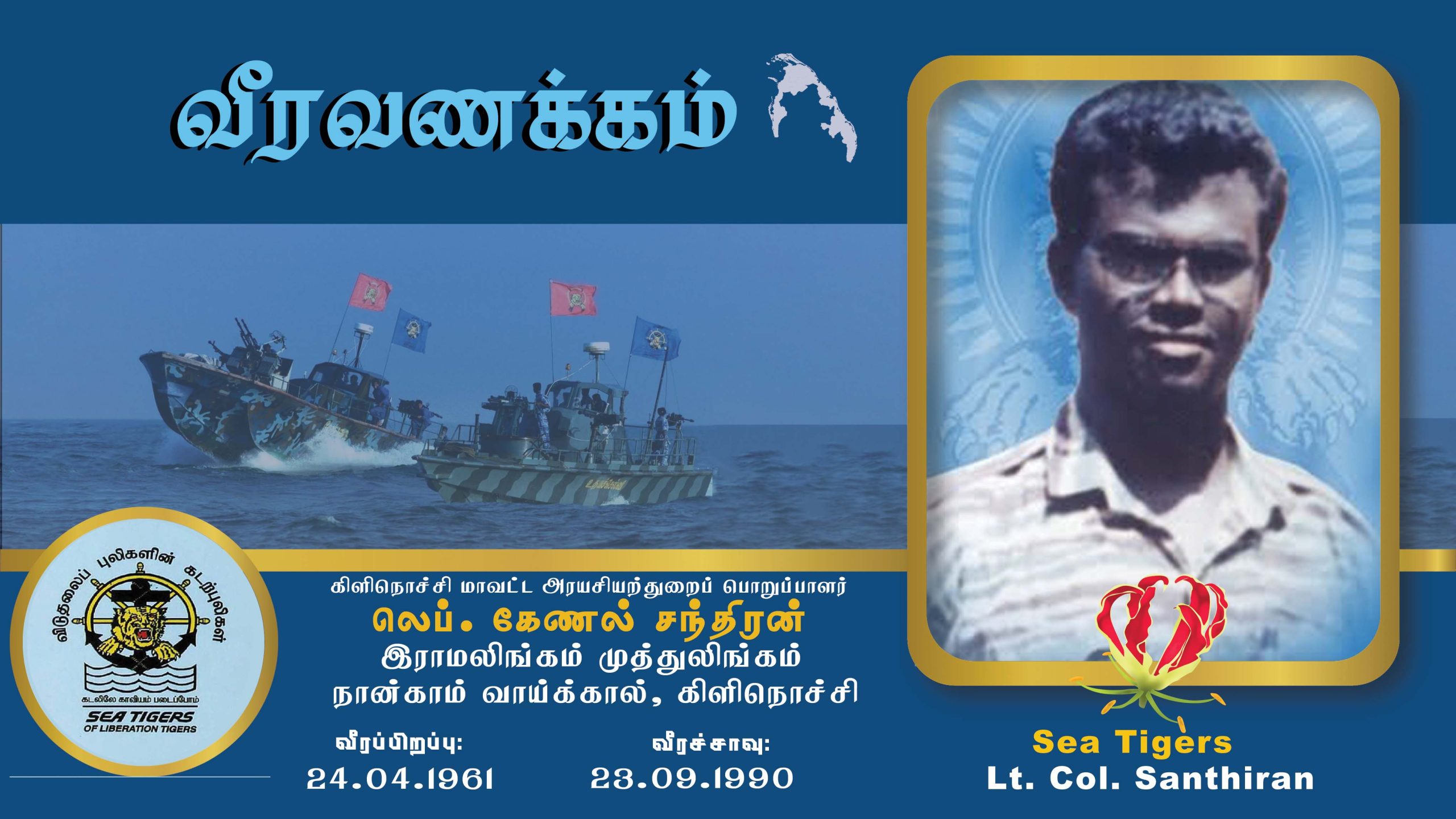
Lt. Col. Santhiran
- The full moon of Vanni.
Have we forgotten you? No. We cannot. We cannot forget not only you, but anyone who loved this land like you and gave life to this land. Santhiran. The children who saw you in Putharikuda, the old women who look for you with their eyes like they are in the mud in Poonagari and Mulliyavalli, the shade trees that caress you and send you on your way, tired and exhausted, but do not see you and are roaring like the waves that swallowed you.
Santhiran, you were a small warrior when you came to Mullaithivu. You can see love and kindness in your eyes but sometimes anger also flares up. You often say: “I was born in a poor family. We lived by working in the fields.” It is true. That is why you have a heart that loves the poor. That is why you always mix with the poor. Once, we went to a village called Putharikuda. There were a few families there who had built small sheds on the edges of the fields. The roofs were leaking. They were getting soaked in the rain and the sun. With longing in their eyes, bare-chested, and bellies swollen with disease, the children of this land stood before us. You suffered. They said they had not bathed for many days.
The neighboring farmer had stopped them, saying that there was no water. They said there was no water even to drink. Hearing that, we knew very well the anguish you felt and the anger you felt towards you. Those poor people should live as human beings in this land. You decided that their own land, a job, and a happy life should be created for them in this land. In fact, as you jokingly say, ‘that too is a battleground’. The large land of Udayar, which had been neglected for a long time, became their own land in small parts. New beautiful houses belong to them.
When preschool was started for that village, we also stood there with you. You gave them new clothes. From the age of six to the age of ten and twelve, all the children had come to study in the preschool class. It was a happy day. It became clear that day that from now on, that village would find a life of its own. A few days passed. The villagers didn’t like the name Putharikuta. They changed it to Santhirapuram. We laughed when we heard that. But the name never changed when you were alive or after your death. You must have had so many great responsibilities after that. But this is where you set foot. This is where your memories are deeply rooted.
Santhirapuram is not the only place that exists as you have told your memories. Poonagari, another village that you created, Navartkadu, Mulliyavalai, which adopted you as its child, Tansiriuthu, Mullaithivu, Pandiankulam, Panangamam. The entire Vanni stands as you have told your memories.
Your heart sometimes cries for your mother. We know how much you cherished your mother. You tell us about your sad youth through your work. During those times, we faced tough tasks. You would work hard and break down. We would stand in awe. “I played the violin at a young age,” you would say. There was a certain longing in your eyes. We will see your eyes. You will be looking for somewhere else.
You were born in Kilinochchi. But your mother and father are from the hills. You were only two years old when your father died. Your two brothers are small children. How hard your mother must have suffered with all your three wars. Nowadays, your mother is probably holding your picture in her hand.
When you were doing political work in Mulliyavalli, sometimes…… we would come looking for you at night. We would hear a sad song at night. We will see you at home. You would be awake. You would go from house to house looking for old rice over the fences. You would not be ashamed of it. Because you were like a child in every house there. They would leave rice at night just to feed you.
You are in the hearts of the people today! We don’t hear you talking about politics. Sometimes we see you. You would be in the courtyard of some house, on a stone. The people in the house would be in front of you, telling stories from their homes. Only then would you tell the events of this land. None of them would know that you were teaching them politics. After you finished talking, they would say, “Everyone must fight for the freedom of this land.”
You came to the Mullaithivu district area to do political work, and two years had passed. During this time, many changes have occurred in you. Your nature of getting angry at anything has also changed. Many changes have also occurred in the Mullaithivu area. The hard work of you and your comrades freed the people from the clutches of anti-national elements. It made people think about the freedom of their land. It inspired people to fight for that freedom.
You know; those were the times when the Indian Army waged a war on our country. It was a time when we could not walk on the streets, nor could we stand in the villages. At night, we would sleep in the forests and on the banks of the forests. You would make us laugh, as we were afraid of the night, with hungry stomachs, expecting danger. As the days passed, those nights full of danger turned into pleasant nights for us. All our comrades would say, “Those difficult days and those memories are still fresh in our minds.”
Even though you are fully involved in political affairs, you never fail to go to the battlefields. Your hands must have pointed guns at the enemy many times. In a fight with the Indian troops at Nedunkerni, you were wounded in the neck and arm. Your comrades said that you were wounded when you advanced to seize weapons on the field. You lay on the bed in our camp, Saiman. The gunshot wound stuck in your neck tormented you. You acted and acted more than that. How many comrades were enjoying your acts.
You will not be able to turn your neck and turn your whole body to look at him. Our entire camp will laugh with delight at you. Even when the Indian forces formed a circle around us and approached us, we were happy in the forests. The Indians may not have known that we were confident in the struggle. Your wound has healed.
At that time, the people of the Mullaithivu region were beaten and driven away by the Indian forces and were living in the forests and fields. You also joined them. You and your comrades instilled confidence in the people in the struggle. You explained to them about the goddess of struggle, about the liberation of this land, and about the purpose of the Indian occupation. It was because the people understood that situation and embraced us that this land did not submit to the aggressor and raised its head high.
It was during those days that you were appointed as the political in-charge of Kilinochchi. The eyes of the people of Mullaithivu district could not bear your division. But you had a great duty before you. After you went to Kilinochchi, you organized and expanded the political division. Your skillful actions brought about good changes in that district as well. During those times, you escaped from the encirclement of the Indian forces two or three times. After the death of Maran Anna, who was the political in-charge of Vanni district, you were appointed as the political in-charge of Vanni district. It was at that time that the Indian forces left this land. You organized the political division throughout Vanni and formulated work plans.
Our newly born KADI organization also grew stronger during those times. In the rallies and meetings, we held at those times, people would listen to your speech with pleasure. We are amazed at how you can speak so easily and clearly, captivating everyone. When the fighting with the Sri Lankan army resumed, everyone knew that you would be there during an attack somewhere. And that is how you stand.
You also participated in the attack on the army camp in Kokka. We won that camp. But that is where a bullet hit you in the abdomen. You were lying in one of our hospitals. Your eyes did not give hope that you would survive. Your body withered away from your firm resolve. We waited with troubled eyes. A few weeks passed. You woke up. But they said your legs would no longer give you. We cannot even imagine a moon without legs. You will never be without dancing, singing, and running. We were suffering. We were confused. But you were lively. Even after you knew your condition, you were enthusiastic. You said from the hospital building, “I am also doing political work here. I am telling the nurses and doctors who come here, and everyone who sees me through these doors, why is there a struggle going on in this land.” It is true. The tragedy where you were, even that hospital, became lively.
Santhiran did not need to walk. He, just being there, was enough. Our minds thought that he would fight, that he would contribute to the struggle. After that, we heard that you and your companions had gone on a journey to the sea in search of medical facilities. We do not know what happened to you. The Sinhala animals that appeared in the sea must have eaten you. You know how to swim. You must have tried to swim with your hands. Your unyielding foot would have dragged you down. The sea would have hesitated for a moment to embrace you. Even after embracing you, it would have been unable to accept you and would have been in a state of turmoil. Just as the minds of the people of Vanni were troubled, the sea would have been in a state of turmoil after embracing you.
Sharing memories: Comrades.
-(09.10.1996) From this magazine “In the field”
(Translation by Tsamilpriya)

0 Comments