×

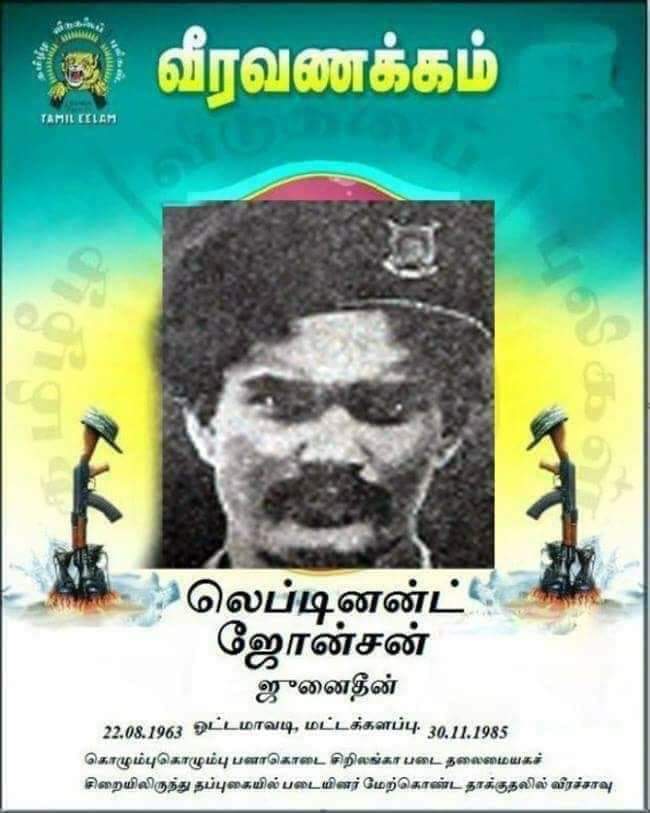
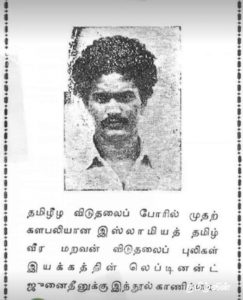
The first Tamil Muslim hero of the Liberation Tigers of Tamil Eelam; Lt. Junaideen (Johnson).

The first Tamil Muslim hero of the Liberation Tigers of Tamil Eelam;

The first Tamil Muslim hero of the Liberation Tigers of Tamil Eelam;
Lt. Junaideen (Johnson).

The role of Tamil Muslims in the Tamil Eelam liberation struggle are both visible and meaningful. In the southern regions of Tamil Eelam, various movements emerged over time. Among them, the “Tamil Eelam Liberation Nagas” (Nagas) gained brief but notable attention. This group was led by Junaideen, a Tamil who followed the religion of Islam from Ottamaavadi.

He actively participated in operations against those supporting the forced incorporation of Tamil Eelam into the Sri Lankan state. When increased crackdowns by the Sri Lankan police dismantled his group’s ability to operate, he transitioned himself to the liberation struggle through the Liberation Tigers of Tamil Eelam.
Junaideen received his training under Ponnamman and Pulendran at the Tamil armed struggle’s third training camp — held in the Indian subcontinent. It was there he was given the name Johnson. This training camp was part of Delhi’s India direct involvement into the Tamil Eelam liberation struggle. At the time, India acting as a regional power broker, hoping to shape and contain the armed movement within its own strategic orbit. That same “India” would later return onto Eelam soil — no longer as an supporter, but as an occupying force.

Under the banner of “peacekeeping,” it turned its guns on Tamil civilians and liberation soldiers alike, leaving behind a record of war crimes and a shattered claim to neutrality.

At the camp, Junaideen often stood out for his distinct abilities. Beyond his discipline as a trainee, he also spent time painting. One of his works — a striking image of a sub machine gun — drew the attention of Tamil Eelam national leader.

Junaidheen (Johnson), who accepted Prabhakaran as his leader, had deep affection for him, as he had started an armed struggle group and fought for ethnic Tamil liberation. Having once led an armed group himself, Junaidheen’s decision to stand under Prabhakaran’s leadership reflected a deep respect for his vision and commitment to Tamil Eelam liberation.

The meetings were deeply engaging. They often delved into the strategies of the liberation struggle, with increasing focus on the work required to foster better understanding between the Tamil people — including Tamil Muslims — and the Moor Muslim ethnic group, which held strongly to its distinct religious identity.
After completing his training in the Indian subcontinent, Junaidheen (Johnson) was sent to Yaalpanam, where he proved his commitment by taking part in the 1985 offensive on the local police station — then a notorious base of the Sri Lankan state forces responsible for brutal crackdowns in Tamil Eelam regions.

He showed his resolve in the 1985 Yaalpanam police station offensive led by Kittu, targeting a center of Sri Lankan police operations that had long been associated with violence against Tamils. He later joined the attack on the Kokkulai army camp on 13/02/1985 and proceeded to Batticaloa, driven by the hope of continuing the fight with renewed energy.

In the aftermath of the Moor Muslims -Tamil riots, the Tamil Liberation Tigers detained several Tamils civilians involved in assaults on Muslim Moors in Manjanthoduwai, bringing them by boat for questioning. It emerged that the Muslim Moors were themselves divided—some aligned with the Eelam liberation movement, while others with the Sri Lankan state. Junaideen (Johnson) was present in person to witness these interrogations.

Calling the Batticaloa leadership separately, who were looking into the matter, he emphasized,

“Both sides have been affected. We cannot side with either faction. The consequences must be balanced and felt equally by all. Deliver a stern warning, but refrain from further measures.”

His calm words were well received,and he emphasized the importance of unity between the two ethnic groups—Tamils and Moor Muslims—in this delicate time.
On 7 May 1985, a clash unfolded at Karadiyanaru involving Sri Lankan police. Junaideen (Johnson) evaded capture by skillfully retreating while firing his Heckler & Koch G3 rifle. At the same time, the liberation movement’s new members were training at a camp in Eralakulam. The engagement escalated when a helicopter, actively assaulting the region from above, was shot down by accurate G3 fire.

During the ceasefire period, Junaideen and fellow liberation fighter Joseph journeyed from Karadiyanaru to Ayithiyamalai. Despite the declared truce, they were arrested by Sri Lankan police and taken to the Panagoda army camp — a place known for its harsh, severe torture and interrogations. Realizing the danger they faced under continued detention, the two planned their escape, knowing that prolonged torture could lead to irreversible consequences.

On 30/11/1985, while confronting soldiers during their escape, both were fatally shot. Junaideen’s death marked a historic moment — the first Muslim to fall in the Tamil Eelam liberation struggle, remembered as a symbol of unity and resistance.
He was born as Junaideen on 22/08/1963 and died as Johnson on 30/11/1985 (22 years old) — a life that bridged identities, and ended in the name of liberation.

{Translated by Dayalan}


guest
0 Comments
Inline Feedbacks
View all comments