
October 08, 1987 – the Indian government betrayed the people of Tamileelam
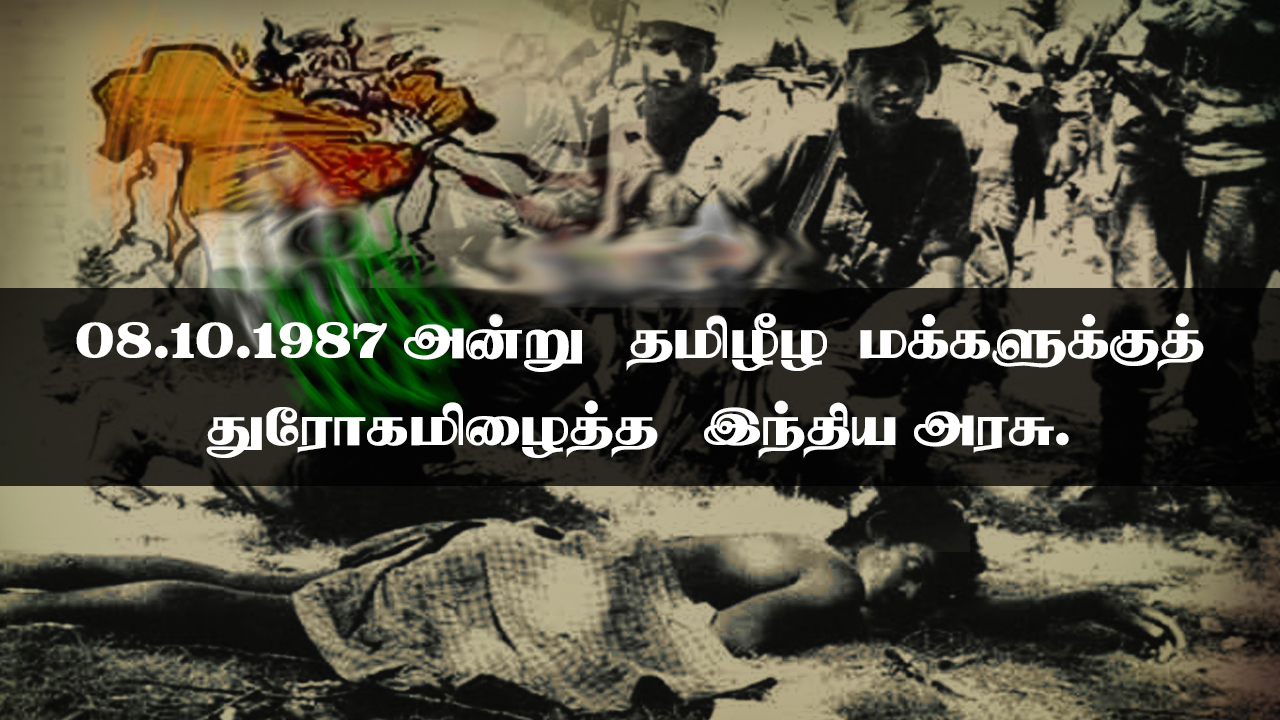
October 08, 1987 – the Indian government betrayed the people of Tamileelam
The Indian forces, which had arrived to maintain peace under the terms of the Indo-Sri Lanka Accord, betrayed the Tamil people and treated them with prejudice. The day after next would mark the first day of the war between India and the Liberation Tigers of Tamil Eelam (LTTE). Regarding how the war between India and Tamileelam began on October 10, 1987, the national leader of Tamileelam, Prabhakaran, wrote a letter to the then-Chief Minister of Tamil Nadu, M. G. Ramachandran, on October 1, 1987, stating:
The unjust killing of our commanders and fighters, acts of violence erupted throughout Tamileelam.
Ethnic clashes broke out. India leveled false accusations against us, claiming that we were responsible for this violence and that we were attempting to break the Accord. Subsequently, in Colombo, Indian Defence Minister Mr. Pant, Indian High Commissioner Mr. Dixit, and Indian Army Chief Lieutenant General Sundarji – along with Sri Lankan President Jayewardene and Minister of National Security Athulathmudali – conspired to eliminate the Liberation Tigers. President Jayewardene announced that the LTTE would be banned and that there would be no amnesty for our fighters.
Mr. Pant declared that India had decided to launch a severe military operation against the Liberation Tigers. Following this, the Indian Peace Keeping Force (IPKF) initiated a malicious offensive against the LTTE.
On the morning of October 10, 1987, the Indian Peace Keeping Force (IPKF) entered the offices of two Tamil daily newspapers – *Eelamurasu* and *Murasoli* – in the city of Yarlpanam. They arrested the staff and subsequently destroyed the printing presses by placing explosives inside them. Later that day, the IPKF, stationed at the Yarlpanam Fort military camp, attempted to enter the city with the objective of hunting down and eliminating the Liberation Tigers of Tamil Eelam (LTTE).
We tried to block their advance, but they opened fire on us. We returned fire in self-defense, and thus the conflict erupted. The Indian Army launched sustained attacks – lasting for hours – on densely populated residential areas, utilizing heavy weaponry such as artillery and tanks. These attacks have continued, resulting in the deaths of not only our fighters but also a large number of civilians.
The Indian Army remains determined to destroy the LTTE, seemingly indifferent to the loss of civilian lives. Surrounded, we are fighting for our own survival. We have taken up arms with the conviction that it is better to die fighting than to be captured alive and face a humiliating death. The war intensified. The Indian forces fought for an entire month in an attempt to seize the Yarlpanam Peninsula. Throughout this conflict, our leader, Prabhakaran, took command and led the Liberation Tigers.
Determining that sustained guerrilla warfare was the most appropriate method to confront the Indian forces, leader Prabhakaran, along with his fighters, retreated into the forests of Tamileelam. The guerrilla campaign continued, inflicting heavy casualties on the Indian troops. Unable to effectively engage the Liberation Tigers, the Indian forces unleashed their fury upon the civilian population, massacring many. They also raped and murdered numerous women.
During this period, leader Prabhakaran sent letters to Indian Prime Minister Rajiv Gandhi – dated October 12, 1987, October 14, 1987, and January 13, 1988 – stating that if a ceasefire were implemented and an interim administration established in the Tamil regions (as per the assurances previously given), he would be prepared to surrender his forces’ weapons. However, driven by a fanatical desire to eliminate leader Prabhakaran, destroy the Liberation Tigers of Tamileelam, and completely eradicate the political aspiration for the liberation of Tamileelam, Rajiv Gandhi deployed hundreds of thousands of Indian troops into Tamileelam.
The war continued.
- From the book: “The Liberation Struggle of Tamileelam and the National Leader of Tamileelam”
(Translation by Tamilpriya)
0 Comments