
The Historic Seal of a Tamil Merchant Guild Discovered in Pathaviya, Eelam
The Historic Seal of a Tamil Merchant Guild Discovered in Pathaviya, Eelam
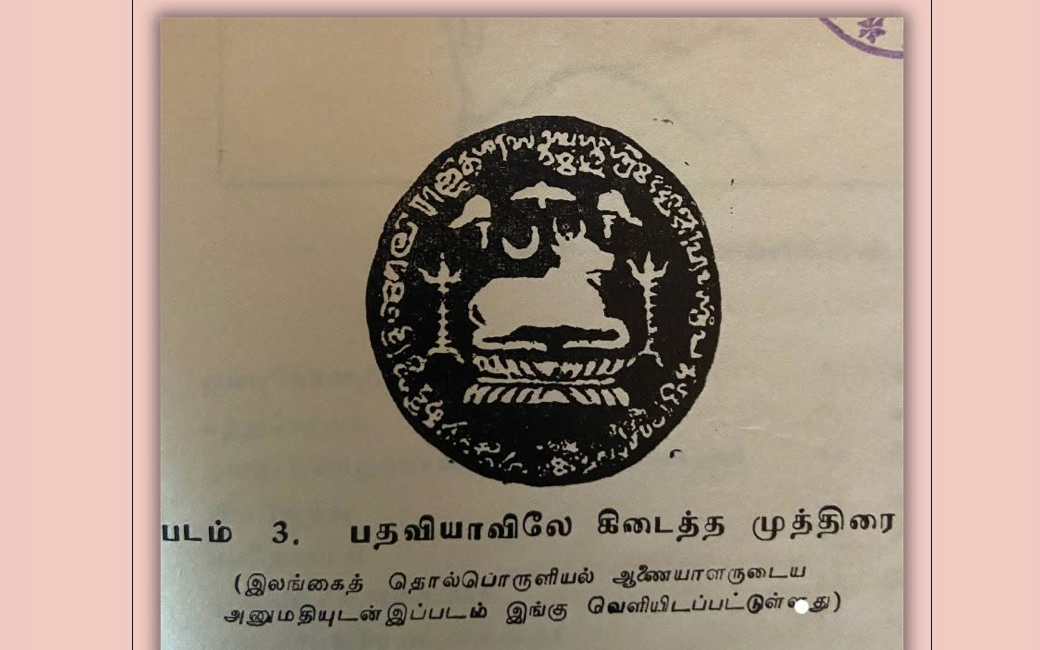
The image shows a historically significant merchant guild seal discovered in the Pathaviya (Padaviya) region of the Anurathapuram District in Eelam.
The location was originally known in Tamil as Pathavi. According to the account, the name was later Sinhalised into Padaviya.
Key Features of the Seal
- Central Symbols
Nandi: At the centre of the seal is a prominently engraved image of a seated bull, representing Nandi.
Auspicious symbols: Traditional standing oil lamps appear on either side of Nandi.
Above Nandi’s head are several auspicious symbols associated with royalty or merchant guilds, including what appears to be a ceremonial fly-whisk (chamara), a flag or an umbrella, together with a crescent moon.
- The Inscription Around the Outer Edge
A Tamil inscription runs around the circular border of the seal.
The inscription contains the words:
“Srimath Thisaiyayirathu Ainnurruvar”
This refers to the celebrated Tamil merchant federation known as Thisaiyayirathu Ainnurruvar (The Five Hundred of the Thousand Directions), which exercised considerable influence in both Tamil Nadu and Eelam during the medieval period.
Historical Background
During medieval times, particularly under Chola rule and in the period that followed, Pathaviya was an important commercial and administrative centre in Eelam.
Several Tamil merchant settlements and Shiva temples existed in this region.
The remains of these settlements and temples can still be seen today.
The seal provides archaeological evidence of the considerable influence exercised by Tamil merchant guilds in this city.
Merchant organisations such as the Nanadesis, Ainnurruvar and Valanjiyar maintained their own military forces and possessed distinctive coins, seals and systems of documentation.
These merchant guilds used seals of this kind to authenticate their merchandise packages, correspondence and official charters.
Archaeological and Historical Significance
This seal is an important archaeological artefact that illustrates the economic strength, administrative organisation and cultural connections of Tamil merchants in medieval Eelam.
It provides valuable evidence of the extensive commercial networks established by Tamil merchant communities and their important role in the island’s economic and cultural history.
Translation by Hari
0 Comments