
The Historic Voyage from Valvettithurai to America in 1938
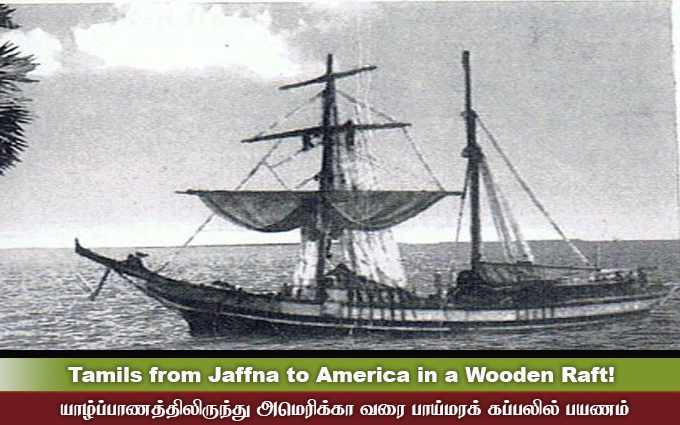
The Annapoorani Ammal: The Historic Voyage from Valvettithurai to America in 1938
Can you believe that the Tamils of Valvettithurai took a ship made of neem wood all the way to America?
The Titanic, built at a cost of millions, sank before completing even half its journey. Yet the Annapoorani Ammal, a sailing ship built by an Eelam Tamil, survived storms and heavy rain to reach America. Just imagine the magnitude of this Tamil achievement!
The American voyage of Annapoorani Ammal – 1938
In 1930, at the Western Street shipbuilding yard in Valvettithurai, a large, two-masted sailing vessel named Annapoorani Ammal was built by Sundaram Meththiriyaar using locally sourced neem wood. At the time, it was a substantial vessel measuring 89 feet in length and 19 feet in width.
Annapoorani is the name of one of the mountain peaks in the Himalayas. Located within the borders of present-day Nepal, it rises to a height of 26,504 feet. Annapoorani is also the name of a Hindu goddess worshipped as the divine giver of an inexhaustible supply of food and nourishment. The name was therefore used for the ship, Annapoorani Ammal.
In the latter part of 1936, an American named Florence C. Robinson, a renowned American sailor who had visited Valvettithurai, was captivated by the beauty of Annapoorani. He wanted to purchase the vessel and take it to America.
After purchasing the ship, he renamed it Florence C. Robinson, after his wife, before taking it to America.
With the assistance of sailors from Valvettithurai, the vessel crossed enormous, turbulent waves and travelled through the Suez Canal before reaching the port of Boston in America. This remarkable achievement continues to be discussed internationally to this day.
While travelling through the Mediterranean Sea via the Suez Canal, the ship encountered a storm and was blown backwards for approximately 250 nautical miles, as far as Beirut.
After crossing thousands of miles and navigating several seas, this daring voyage finally concluded on 1 August 1938 at the port of Gloucester, in the state of Massachusetts, USA.
A sailing vessel built in Valvettithurai, a small town on an island in South Asia, had travelled with the aid of the wind across the Indian Ocean, through European waters and the Mediterranean Sea, and then across the Atlantic Ocean to reach Gloucester in America.
According to the account, this was the first and last time in world history that such a voyage was accomplished by a vessel of this kind.
Five sailors from Valvettithurai participated in the historic voyage all the way to its final destination. They were led by Thandayal Kanagarathinam Thambippillai, aged 48, and included:
- Pooranaveluppillai Subramaniam, aged 29
- Thamotharampillai Sabarathinam, aged 28
- Chinnathamby Chidambaram Pillai, aged 28
- Aiyathurai Rathinasamy, aged 24
A photograph taken while the ship was anchored at Baltimore, near Washington, D.C., was published by The Baltimore Sun, together with an article about the voyage.
Under the command of Captain McQuies, and with the assistance of sailors from Valvettithurai, the ship made its way to Gloucester, America. The reports published by the media in Gloucester at the time remain important testimonies and evidence of this extraordinary achievement.
The significance of Annapoorani Ammal’s thrilling voyage has been further enhanced by books and literary works, as well as articles published in newspapers and magazines.
Details of this remarkable voyage appeared in The Boston Globe on 2 August 1938, in an article titled “Voyage Ended by Brigantine Barrows.”
Another daily newspaper published that same day, The Gloucester Times, carried a front-page story titled “Ceylon Brig Arrives After Long Voyage.”
The following passage from the newspaper offers an insight into how Western observers viewed the maritime capabilities of the Tamils:
“The true story of a long sea voyage tells of a vessel built in Valvettithurai, spreading its nine sails and proudly swaying as it sailed across the Atlantic Ocean to reach the eastern coast of America. Ships of this kind were built in Valvettithurai and neighbouring Paruthithurai and were navigated by sailors from Valvettithurai. They were built by master shipbuilders in Valvettithurai and Paruthithurai, in the north of Ceylon, for wealthy Chettiars in Tamil Nadu, Chettiars residing in Valvettithurai, and merchants from Valvettithurai.”
The sailors from Valvettithurai who arrived in America aboard Annapoorani Ammal brought back with them newspaper clippings and reports documenting the voyage. The above passage is among those records.
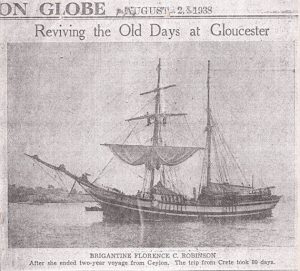
Annapoorani’s second extraordinary voyage to Tahiti
In the third month after reaching America, Annapoorani embarked on another daring voyage, setting out for the island of Tahiti in the South Pacific Ocean on 22 November 1938.
Once again, the ship was caught in a severe storm that lasted three days.
The vessel continued its journey, overcoming winds blowing at 100 miles per hour in the Atlantic Ocean and waves rising to a height of 40 feet.
The strength of the neem-wood construction from Valvettithurai, together with the shipbuilders’ craftsmanship and technical expertise, is credited with contributing to this success.
Ultimately, after travelling 8,196 miles, the ship reached Tahiti in the Pacific Ocean on 15 February 1939, successfully completing its second remarkable voyage.
Two books, Tahiti Bound and Wanderer, have been published about Annapoorani’s journey to Tahiti.
A photograph of the vessel, taken while it was anchored near the port of Baltimore, close to Washington, D.C., during Florence C. Robinson’s voyage, reveals the striking and majestic appearance of Annapoorani. The double-masted sailing ship can be seen moving forward with all nine of its sails fully spread.
Even today, people around the world proudly speak of the historic achievement in which sailors from Valvettithurai navigated the ship through enormous, surging ocean waves, passed through the Suez Canal, and delivered it safely to the American port of Boston.
The final chapter of Annapoorani
Having accomplished so much and travelled across the world through the Indian Ocean, the Atlantic Ocean, and the Pacific Ocean, Annapoorani eventually met its end in 1957, when it sank near Tahiti.
Nevertheless, the double-masted sailing vessel known as Annapoorani Ammal, which undertook such daring maritime journeys, remains a proud symbol of Valvettithurai.
The voyage remembered by an American ambassador in 2016
On 15 August 2016, American Ambassador Atul Keshap visited Yaalpaanam (Jaffna) for an event associated with Operation Pacific Angel, a joint initiative involving American and Sri Lankan military personnel.
During his speech, he pointed out that the maritime connection between America and Eelam had been renewed through the sailors of Valvettithurai, who arrived at Gloucester, America, aboard the sailing vessel Annapoorani Ammal.
He connected this voyage with the earlier relationship established through American missionaries who had arrived in Ceylon in 1813. He also emphasised that Annapoorani’s remarkable sea voyage was an event of historical significance.
An American had thus brought attention back to an event that the people of the island, including the Eelam Tamils themselves, had largely forgotten for decades.
Another incident worth recalling occurred in May 1987, when Sri Lankan forces launched a major offensive known as Operation Liberation, under the direction of Lalith Athulathmudali, who was then the Minister of National Security. The operation was intended to capture Vadamaratchi.
Following this offensive, several officials associated with the World Bank visited Valvettithurai. One of them had a detailed conversation about Annapoorani Ammal’s voyage with Mr. V. Velumayil, who was serving as the Assistant Government Agent at the time.
This, too, is a noteworthy episode in the story of the ship and its place in the history of Valvettithurai.
The maritime achievements of the Tamils
Around 75 years earlier, at a time when modern technology and scientific methods had not yet developed to their present levels, Tamils built numerous sailing vessels from locally available neem wood, ships capable of cutting through the waters with the power of the wind.
The Tamils of Valvettithurai travelled not only to America but also to ports such as Burma, Kakinada, and Thoothukudi, establishing commercial connections, conducting trade, earning wealth, and bringing pride to their homeland.
These achievements stand as a testament to the shipbuilding skills, maritime knowledge, courage, and commercial enterprise of the Tamils of Valvettithurai.
Translation by Hari
0 Comments