×

Eelam


A Tamil Young Woman in the 19th Century 

A Tamil Young Woman in the 19th Century  This is one of the historical photographs taken in Ceylon (present-day Eelam) […]...
 
Read More

At the southern tip of the island of Eelam, deep within the heart of dense forests

At the southern tip of the island of Eelam, deep within the heart of dense forests At the southern tip […]...
 
Read More

Study of the Vedukkunari Hill Inscriptions

Study of the Vedukkunari Hill Inscriptions The following three inscriptions are found at Vedukkunari Hill, located in the Olumadu area of Nedunkeni, […]...
 
Read More

In studies of the ancient language of the island of Eelam (Sri Lanka)

In studies of the ancient language of the island of Eelam (Sri Lanka) In studies of the ancient language of […]...
 
Read More

Archaeological and historical research conducted so far in Eelam has confirmed

Archaeological and historical research conducted so far in Eelam has confirmed that the origin of the Tamil language dates back […]...
 
Read More

The Inscription of Venkasipan and Its Historical Significance

The Inscription of Venkasipan and Its Historical Significance “Venkasipan Kodupita Kal Kanjanam” (வெண்காஸிபன் கொடுபித கல் கஞ்சனம்) This inscription is found at Marukalthalai, in the Tirunelveli District of Tamil Nadu. Its meaning is that a stone bed or stone shelter was constructed and donated to Venkasipan. Since Venkasipan was […]...
 
Read More

The fact that the Tamils, the original inhabitants of the island of Sri Lanka

The fact that the Tamils, the original inhabitants of the island of Sri Lanka The fact that the Tamils, the […]...
 
Read More

Evidence of Stone Age Human Settlements Discovered in the Panikkankulam Forest Region

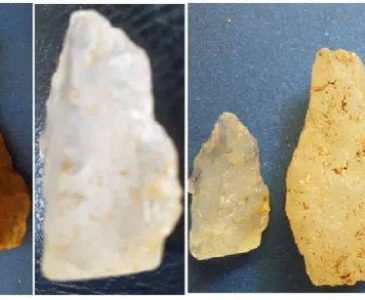
Evidence of Stone Age Human Settlements Discovered in the Panikkankulam Forest Region Stone tools used for hunting by prehistoric humans have been discovered along the banks of the Panikkankulam River, in a forested area approximately ten kilometres south of the main road between Kokavil and Maankulam. Two residents of Panikkankulam, Mr. Gajan and Mr. Jeyakanthan, sent us a photograph of a black stone found along the riverbank in the forest. The stone appeared to have been used for grinding grain. Because the shape of this stone and its apparent function suggested considerable antiquity, we visited the location this week together with archaeology lecturer Mr. K. Kirikaran. Mr. Gajan and Mr. Jeyakanthan assisted us in reaching the site. Archaeological Evidence of Ancient Settlements At present, only a few settlements are found within approximately one mile of the main road in this forest region. The remaining territory, extending as far as Vannerikkulam, consists of dense forest that is largely unsuitable for human habitation. However, reliable archaeological evidence found in considerable concentrations along both banks of the river confirms that densely populated settlements existed in this area as early as 2,000 years ago. Among the archaeological materials discovered on the elevated ground near the river were pottery fragments of various sizes and shapes, bricks, iron deposits and everyday objects fashioned from black stone. These discoveries resemble archaeological evidence associated with the Early Iron Age, also known as the Megalithic cultural period, found at several important sites. In Eelam, comparable evidence has been discovered at Kantharodai, Kaddukkaraikulam and Anurathapuram. In Tamil Nadu, similar archaeological remains have been found at Adichanallur, Alagankulam and Arikamedu. Evidence of Stone Age Communities Before the Megalithic Period An especially important aspect of these discoveries is the evidence suggesting that Stone Age communities inhabited this region before the emergence of permanent settlements associated with Megalithic culture. These early inhabitants lived as nomadic hunter-gatherers, hunting animals for food. Reliable evidence supporting their presence has been discovered along the riverbanks. The finds include small, carefully fashioned stone tools made from quartz and chert, together with stone flakes produced during the manufacture of these implements. These discoveries indicate that Mesolithic or Microlithic communities lived in this region several centuries before the emergence of Megalithic culture. The Prehistoric Cultural History of Eelam […]...
 
Read More

Why Was Prakrit Used in the Ancient Inscriptions of Eelam?

Why Was Prakrit Used in the Ancient Inscriptions of Eelam? The Ritigala Inscriptions – IC 268 and IC 269 Inscription IC 268 (Ritigala) “Mahamata Pamatta Puta Parumaka Pusagutta Karite Pata Thupa” Who was the individual referred to in this Ritigala inscription as Mahamata Pamatta Puta Pusagutta? Inscription IC 269 (Ritigala) The inscription states: “Mahamata Pamatta Puta Parumaka Patige Parumaka Pusagutta Parumaka Mitthe, Parumaka Tise Karite Arita Mahagame” Through this inscription, we can identify the sons of Mahamata Pamatta. The Vedukkunaari Malai Inscription – IC 373 Inscription IC 373 (Vedukkunaari Malai) “Mahasamutta Puta Guttaha Lene Sagasa, Parumaka Pamatta Puta Ha Mahaguttaha Lene” […]...
 
Read More

The Historical Truth About Eelam: Who Are the Real Original Inhabitants?

The Historical Truth About Eelam: Who Are the Real Original Inhabitants? For generations, Sinhala Buddhist supremacists have spread false propaganda claiming that Eelam is a “Sinhala Buddhist country” and that this land belongs exclusively to them. However, when we examine the pages of history, it becomes clear that these claims are not only baseless but also represent an enormous historical deception. For a group of people who migrated from North India to call the Tamils, the original inhabitants […]...
 
Read More