Eelam

Ancient Inscriptions of Eelam
Ancient Inscriptions of Eelam: The Pandyan Royal Lineage, Makkhali Gosala and the Historical Connections Between the Rulers All ancient inscriptions of Eelam are closely interconnected, either directly or indirectly. Through the information recorded in these inscriptions, it is possible to identify the genealogical relationships that existed between the individuals mentioned in them. In this context, let us examine the following inscription. The Vedukkunaari Malai Inscription – IC 373 The inscription IC 373, located at Vedukkunaari Malai, states: “Maha Samutta Puta Gutta Sa Lene, Sagasa” “Parumaka Pama Datta Guttaha Maha Gutta(ha) Lene” According to this inscription, Maha Samutta donated a stone bed to his son, Maha Guttaha. The following inscription indicates that the individual referred to as Datta was Gamani Tissa, the son of Gamani Abhaya, who was also known as Majima Raja. Inscription IC 1045 “Sagasa Pamana Mogali Puta Parumaka Majima Puta Dataha Lene” In this inscription, Pamana Mogali refers to the Pandyan ruler Devanapiya Gamani Uthi. His son, Majima, was Devanapiya Gamani Abhaya. The inscription refers to Majima’s son, Devanapiya Gamani Tissa, as Dataha or Dattaha. The following inscription provides further evidence establishing that Majima Raja was the father of Gamani Tissa: “Gamani Tissaha Pitaha Niyata Majima Rajaha Cha Niyata Gamani Tissaha” Therefore, Majima Raja was the father of Gamani Tissa. Other inscriptions also identify Majima Raja as Devanapiya Gamani Abhaya. Consequently, the individual described in the Vedukkunaari Malai inscription as Parumaka Datta Guttaha Maha Guttahawas Devanapiya Gamani Tissa. This means that his father, Maha Samutta, was Majima Raja, also known as Devanapiya Gamani Abhaya. […]...
Puranar, Makkhali Gosala and the Ancient Ajivika Philosophy of Eelam
Puranar, Makkhali Gosala and the Ancient Ajivika Philosophy of Eelam The very meaning of Puranam is completeness or perfection. Thiruvalluvar refers to such a being as Vaal Arivan — the One Possessing Perfect Knowledge. He uses this expression to describe the Aadhi Bhagavan, the Primordial Divine Being who attained such a state of perfection. In the Tamil Buddhist epic Manimekalai, associated with Mahayana Buddhism, verse 27:112 refers to the Ajivika teacher through the expression: “Varambil Arivan Irai Nool Porul” This means, “Our Lord is the One who possesses limitless knowledge.” That this refers to Makkhali becomes evident later in verse 27:165, which states: “Makkhali Noolin Vagaiyithu Venna” This indicates that the philosophical teachings being discussed belong to Makkhali. Consequently, there are reasons to consider that Puranar and Makkhali were the same individual. Ancient inscriptions from Eelam provide further support for this interpretation. These inscriptions contain references such as Bhagavatha Mogali Gothama Samana Buddha, which appear to identify Makkhali. Furthermore, inscriptions from Eelam indicate that a place of worship dedicated to the sacred feet of Puranar was established at the summit of Sivanolipatha Malai, also known as Sumanakoodam. The deity referred to as Sumana Saman, who is traditionally associated with the establishment of this sacred place, has been identified as King Dhamma Raja, the eldest among the ten sons of King Abhaya, who belonged to the Pandyan royal lineage of Eelam. This strengthens the possibility that Puranar was indeed Makkhali. Research into Makkhali through the inscriptions of Eelam suggests that he was the Pandyan king Gamani Uthi. He was the first ruler identified in the inscriptions of Eelam by the title Devanapiya Gamani Uthi. However, while no temple dedicated specifically to Gamani Uthi has been identified anywhere in Eelam, the temple associated with Puranar has been given particular prominence. This is presented as further evidence that Makkhali and Puranar were the same person. According to the inscriptions, before Makkhali renounced worldly life, he was a Pandyan ruler with two wives: a princess bearing the title Abhi Anurathi and a woman named Sumana Devi. It is therefore possible that these two women were later known as Puranai and Porkalai. […]...
Sri Lanka does not belong only to the Sinhalese
Sri Lanka does not belong only to the Sinhalese: Although The island of Sri Lanka is today presented as a […]...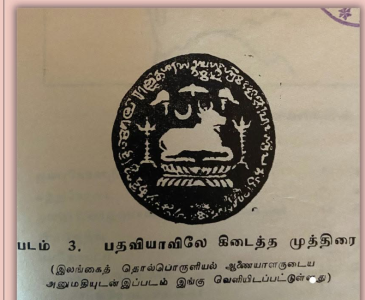
The Historic Seal of a Tamil Merchant Guild Discovered in Pathaviya, Eelam
The Historic Seal of a Tamil Merchant Guild Discovered in Pathaviya, Eelam The image shows a historically significant merchant guild seal discovered in the Pathaviya (Padaviya) region of the Anurathapuram District in Eelam. The location was originally known in Tamil as Pathavi. According to the account, the name was later Sinhalised into Padaviya. Key Features of the Seal Central Symbols Nandi: At the centre of the seal is a prominently engraved image of a seated bull, representing Nandi. Auspicious symbols: Traditional standing oil lamps appear on either side of Nandi. Above Nandi’s head are several auspicious symbols associated with royalty or merchant guilds, including what appears to be a ceremonial fly-whisk (chamara), a flag or an umbrella, together with a crescent moon. The Inscription Around the Outer Edge A Tamil inscription runs around the circular border of the seal. The inscription contains the words: “Srimath Thisaiyayirathu Ainnurruvar” This refers to the celebrated Tamil merchant federation known as Thisaiyayirathu Ainnurruvar (The Five Hundred of the Thousand Directions), which exercised considerable influence in both Tamil Nadu and Eelam during the medieval period. Historical Background During medieval times, particularly under Chola rule and in the period that followed, Pathaviya was an important commercial and administrative centre in Eelam. Several Tamil merchant settlements and Shiva temples existed in this region. The remains of these settlements and temples can still be seen today. The seal provides archaeological evidence of the considerable influence exercised by Tamil merchant guilds in this city. Merchant organisations such as the Nanadesis, Ainnurruvar and Valanjiyar maintained their own military forces and possessed distinctive coins, seals and systems of documentation. These merchant guilds used seals of this kind to authenticate their merchandise packages, correspondence and official charters. […]...
How Did the Sinhalese Become the Majority Population in Eelam?
How Did the Sinhalese Become the Majority Population in Eelam? When we examine the history of Eelam closely, an important question arises: If the Tamils were the indigenous and earliest inhabitants of this island, how did the Sinhalese become the majority in its present-day population? There are several reasons for this. One of the most important, historically, was the gradual assimilation of Tamils and other Dravidian communities […]...
Tolkappiyam: A Literary Heritage Given by Eelam
Tolkappiyam: A Literary Heritage Given by Eelam The following verse indicates that the Chera and Chola dynasties originated from the Pandyan lineage, which was the earliest royal dynasty to emerge in ancient Tamilakam. “Thalaiyavai Kaalaththu Thalaivar Immurai Maran Valuthi Maran Thiraiyan Maran Poraiyan Or Vaguppil Vanthanar Tamil Moovar Asivar Thaamaavaare.” — Narkudi Velalar Varalaru, Prefatory Verse According to this verse, the three Tamil royal dynasties originated from a common […]...
A Study of Special Terms Found in Philosophical Inscriptions of Eelam
A Study of Special Terms Found in Philosophical Inscriptions of Eelam Parumaka (This was a general term referring to everyone. The earliest inscriptions used the form Parumakan. Later, the form Parumakanth can be seen. Its feminine form was Parumakal. All these forms subsequently disappeared, and the term Parumaka came into use.) (1) Parumaka Sumana puta Parumaka Tisaha leṇe. (The cave of Tisa, son of Sumana.) Upasaka was the first stage in the philosophical tradition of that period. Its feminine form was Upasika. (2) Jotitheraha Mahasutasane Upasaka Tisaya Theraha Naga leṇe. (The […]...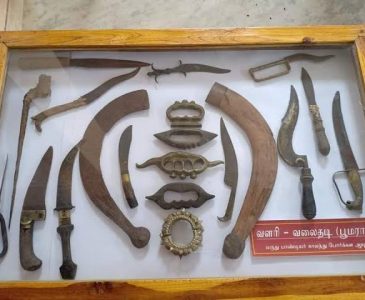
Weapons of War Used 300 Years Ago – A Living History
Weapons of War Used 300 Years Ago – A Living History During the 16th century, under the rule of the […]...